| |
| |
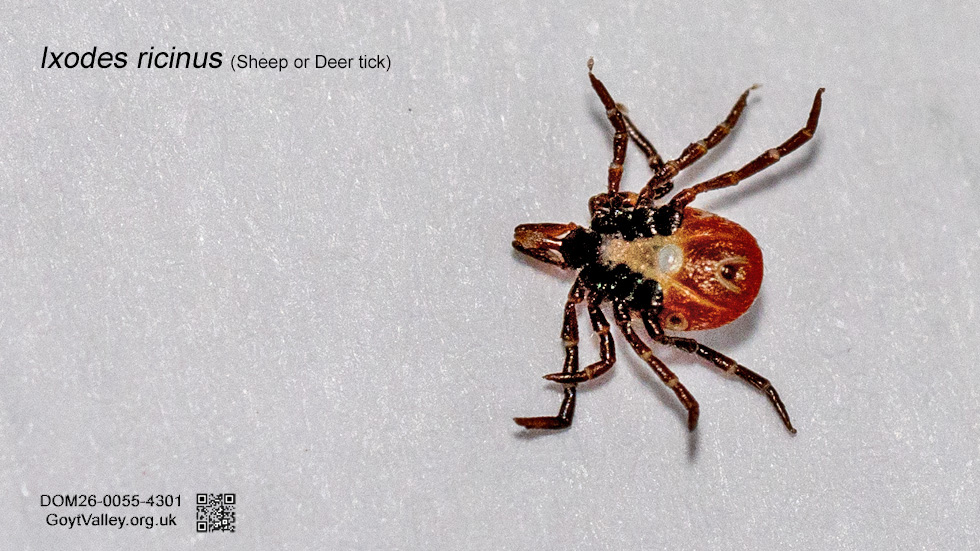
| I am breaking with my default presentation because I am guessing there will only ever be one entry under this heading. This example of Ixodes ricinus is real and as best I can determine, was acquired by me in the Goyt Valley, June 19th. 2026 (a Friday). I usually hunt targets for my lens but this one hunted me. It is an adult female and unfed. Located about 100mm below my knee inside my right leg and well dug in. Spotted when showering following my trip to the Goyt. I used my proprietary tick removal kit to extract the beast alive. It was quick to move on my notepad, before being housed in a small plastic vial, subsequently placed in the fridge overnight, before being despatched to HMG at Porton Down from the Post Office, Saturday morning. HMG encourages people to submit sightings and HMG subsequently confirmed my own identification within a couple of weeks (they do not report on pathogens). |
| |
| Having a long-standing interest in this subject, I have acquired a great deal of knowledge over time. That knowledge ironically persuades me not to attempt to compile any information here on the subject of ticks. It is a vast (and interesting) subject. Tonnes of information already out there on the internet on this subject and some of it is useful in the UK. However, much of the information out there is not necessarily relevant to the UK, useful or even accurate. In short, I only recommend relying on one safe source and this central government source will open in a new window: https://www.gov.uk/government/collections/ticks - Anything you need to know is there. It is a one-stop-shop. |
| |
 |
| |
| Comment: The subject is heavily nuanced with imponderables. As a basis for discussion only, I will suggest the presence of Deer in the Goyt Valley is essentially irrelevant. Whenever the topic of ticks is mentioned, lay people often accuse the Red Deer. I would also include sheep now. Sheep were absent from the Goyt for decades and were only reintroduced to restricted areas (East) in the past three years, notwithstanding the occasional straggler.
That said, for the most part, paths utilised principally by human visitors are generally free of the kind of vegetation where ticks lurk when ‘questing’ for a host or victim. But there are exceptions. East of the Errwood Reservoir in particular, is a popular well-established route. From the Pack Horse Bridge for a (GPS measured by me) distance of 1.5km the path is continuously overgrown, all year round. That vegetation on both sides of the path is invariably in physical contact, forming an arch across the narrow but well-worn path.
The latter route often appears ‘muddy’ in parts and in some areas at times is almost impassable bog. I have seen people turn back at its worse. Endless leaf mould underfoot by definition (bog) which is capable of harbouring ticks temporarily and otherwise in danger of desiccating in hot weather, in that exposed location. Numerous vernal pools and soft or squishy areas. I see boot prints and paw prints but never any spoor? No wool or fur snagged on vegetation*. No cloven-hoof prints. No deer/sheep faecal droppings. This tells its own story.
Although popular, even on nice weekends the number of people met with on this route (my Route 6) is not really substantial as it offers some challenges. NB: The Bunsal Cob end does get busier for a distance of 0.5km with local dog walkers but the grass there short.
I could add a lot more on the topic but I would not (indeed cannot) offer any opinion on the likelihood of meeting with ticks because whatever I (or anyone else) may say, would be wrong. I am invariably covered head to toe anyway, both winter and the hottest days, but the main conscious motivation for that is to reduce the number of bites from flying insects, which I still get anyway, hence I carry Hydrocortisone cream as well as my tick removal kit. |
| |
| For your interest an example of a government download from their website above on UK tick species: |
| |
| * Bracken, Gorse, Ling, Bell Heather, Nettles, Grasses, Birch |
| |
| top |
| |
|
|


